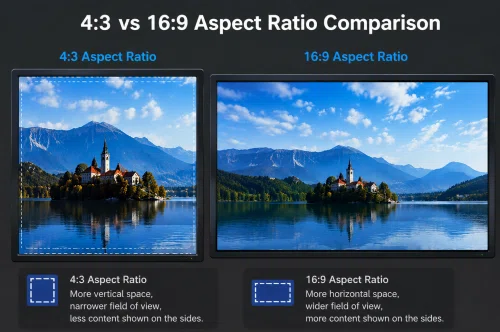
When selecting an Industrial LCD display panel, most buyers face a key question: Which aspect ratio performs better—4:3 or 16:9 LCD display panels? With leading manufacturers such as BOE, AUO, and Innolux (Chimei) continuously upgrading production lines, 16:9 widescreen LCD panels have become the mainstream standard, while traditional 4:3 LCD display modules are gradually shifting into niche industrial applications.
This article provides a full analysis of: ♦ LCD aspect ratio definition ♦ 4:3 industrial LCD panel advantages and disadvantages ♦ 16:9 TFT LCD display advantages and disadvantages ♦ LCD Panel Selection Suggestion
The aspect ratio of an LCD display panel refers to the proportional relationship between screen width and height of the active display area. It is a critical parameter affecting:
• Display format and visual experience
• Content compatibility
• TFT LCD display module integration design
Many users focus only on resolution, brightness, or contrast ratio, but ignore aspect ratio—resulting in image stretching, black borders, cropping issues or poor UI/UX in embedded systems.
Common industrial LCD aspect ratios include:
♦ 4:3 LCD panel (industrial square-type display)
♦ 16:9 LCD panel (widescreen HD TFT display module)
♦ 4:3 industrial LCD display panel: Provides a more square format, widely used in legacy industrial systems and embedded equipment.
♦ 16:9 widescreen LCD module: Standard HD format used in modern video, computing, and commercial displays.
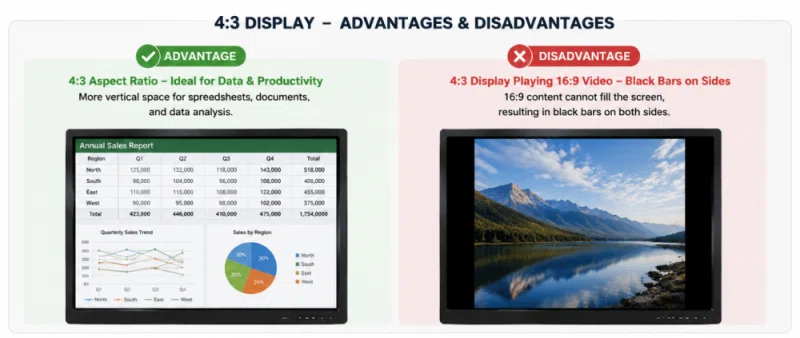
The 4:3 LCD display panel is a traditional industrial standard widely used in early HMI systems, CNC machines, medical equipment, POS terminals, and security monitoring systems. Today, 4:3 TFT LCD modules remain essential in industrial applications.
Compared with widescreen displays, 4:3 LCD panels provide higher vertical resolution usage, making them ideal for industrial control systems (HMI LCD display), PLC interfaces, monitoring dashboards, data tables and logs and embedded automation systems. They can display more rows of data without scrolling.
4:3 LCD display modules are widely integrated into CNC machines, medical diagnostic devices, POS systems, industrial embedded controllers and security surveillance monitors etc.
Under the same resolution, 4:3 LCD panels provide sharper text edges, clearer line rendering and better readability for engineering data.
• Limited horizontal viewing area for widescreen content
• Not suitable for modern HD video formats
• Fewer available models and higher relative cost
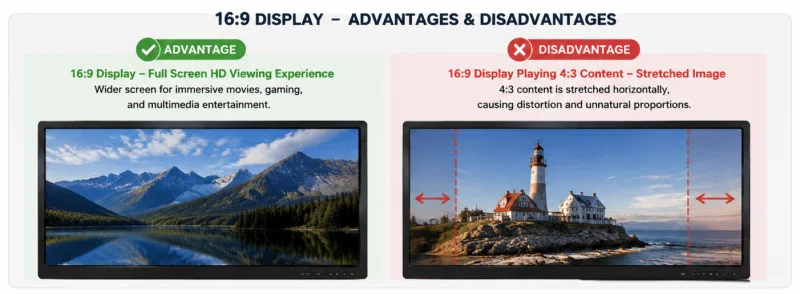
The 16:9 TFT LCD display panel is currently the global mainstream standard, widely used in consumer electronics and commercial displays.
16:9 LCD displays support 1080P / 2K / 4K video, industrial PC systems, multimedia interfaces and digital signage displays etc. No distortion, no black bars, full-screen output.
The widescreen format provides wider field of view, better immersive experience, improved multitasking efficiency and smoother video and UI interaction
Because manufacturers mass-produce 16:9 TFT LCD panels:
• more model options
• lower unit cost
• higher supply chain stability
• better price-performance ratio
• Reduced vertical space for industrial data
• Requires more scrolling in tables and long documents
• Less efficient for high-density information display in HMI systems
There is no absolute better LCD panel—only the most suitable industrial application.
• industrial HMI control panels
• embedded systems
• CNC machine interfaces
• medical equipment displays
• security monitoring systems
• high-density data visualization
• industrial PCs and monitors
• video playback systems
• advertising displays (digital signage)
• office and multitasking environments
• multimedia and gaming applications
If you are a manufacturer of industrial equipment, 4:3 aspect ratio LCD panels offer unmatched advantages over 16:9 widescreen displays in industrial control, medical, automotive, security monitoring, and data visualization applications. The vertical display advantage of 4:3 screens, higher content accuracy, and superior equipment compatibility cannot be matched by 16:9 widescreen LCD panels.
If you are unsure whether 4:3 or 16:9 displays are better, the selection depends on the application scenario: for general home use, office work, entertainment, and digital signage, 16:9 LCD display panels are recommended; for industrial control, security surveillance, and professional data display applications etc, 4:3 LCD panels should be prioritized. Choosing the correct aspect ratio is essential to maximize the display performance of LCD panels.
Zhengzhou Hengxinda Technology Co., Ltd. is a professional supplier of industrial display panels and an authorized distributor of well-known manufacturers such as AUO, BOE, Chimei Innolux, IVO, Sharp, and NLT. We also provide one-stop supporting solutions including compatible touch panels, driver boards, and customized cables. Welcome to contact us for guidance on selecting the most suitable industrial LCD display panel.

Please enter your information and provide your contact information, we will contact you as soon as possible.
Please enter your name and email address to start the download.